


Haunted Real Estate: The Spooky History Behind NYC’s Most Storied Addresses
In New York City, every address has a past, and some of them refuse to stay buried. As the leaves turn in Central Park and brownstone stoops fill up with jack-o’-lanterns, it’s the perfect season to look at haunted NYC real estate: the mansions, rowhouses and apartment buildings whose ghost stories have outlived their original owners.
These tales are more than campfire material. A haunted reputation can shape how a property is marketed, how long it sits on the market, and even how a court treats a sale. Below, we walk through six of the city’s most storied addresses, the landmark New York case that declared a house “haunted as a matter of law,” and what today’s buyers and renters should actually know about stigmatized property in New York.
The “Ghostbusters Ruling”: When a New York Court Declared a House Haunted
Any conversation about haunted real estate in New York starts with Stambovsky v. Ackley. Decided on July 18, 1991, by the Appellate Division, First Department, the case is still known as the “Ghostbusters ruling”.
The house sat at 1 LaVeta Place in Nyack, just up the Hudson, but the buyer was a city man. According to StreetEasy’s history of the case, seller Helen Ackley had described the house’s ghosts years earlier in a 1977 Reader’s Digest piece. Buyer Jeffrey Stambovsky, coming from Manhattan, hadn’t heard the local lore, as HeinOnline notes. He put down $32,500 toward a $650,000 purchase, then sued to cancel the deal once he learned of the house’s reputation.
The court sided with him. Because Ackley had publicized her spectral roommates herself, she couldn’t deny them in court. The judges reasoned that a widely known haunted reputation hurt the home’s value and resale potential, and an out-of-town buyer would have no reason to ask about it. As the ABA Journal recounts, Justice Israel Rubin’s majority opinion delivered the now-famous line that the house was haunted “as a matter of law.”
What New York law says now
More clarity came a few years later. Under New York Real Property Law § 443-a, it is not a material defect that a property was the site of a homicide, suicide, or other death, or of a felony. Sellers and their agents can’t be sued simply for staying silent about those facts.
There is a catch for curious buyers. The statute lets a buyer submit a written inquiry about these issues, and the seller may choose whether to respond. The law also says nothing explicit about ghosts, which is why Stambovsky still gets cited whenever a seller has been actively promoting a property’s paranormal past.
1. Morris-Jumel Mansion, Washington Heights: The Ghost Who Got a Discount
Perched on one of the highest points in the city, the Morris-Jumel Mansion is Manhattan’s oldest house. It was built in 1765 for British Army Colonel Roger Morris and his wife, Mary Philipse-Morris, and later served as George Washington’s headquarters during the Revolution.
Here’s the twist every real estate buff will love. When Stephen and Eliza Jumel bought the house in 1810, Eliza reportedly talked $2,000 off the asking price by claiming the place was haunted. It may be the earliest recorded case of a New Yorker using a ghost as a negotiating tactic.
Eliza went on to become one of the richest women in New York, and many say she never left. Museum staff describe footsteps, whispers and shadows, and the mansion’s best-known tale involves a woman on the balcony scolding a noisy school group in the 1960s. When the children described her, the curator recognized Eliza Jumel, who had been dead for about a century. The museum has even hosted paranormal investigation tours.
2. Merchant’s House Museum, NoHo: “Manhattan’s Most Haunted House”
At 29 East Fourth Street stands a rowhouse that hardware merchant Seabury Tredwell bought for $18,000 in 1832. His family lived there for roughly a century, and it was the first building in Manhattan to be designated a landmark.
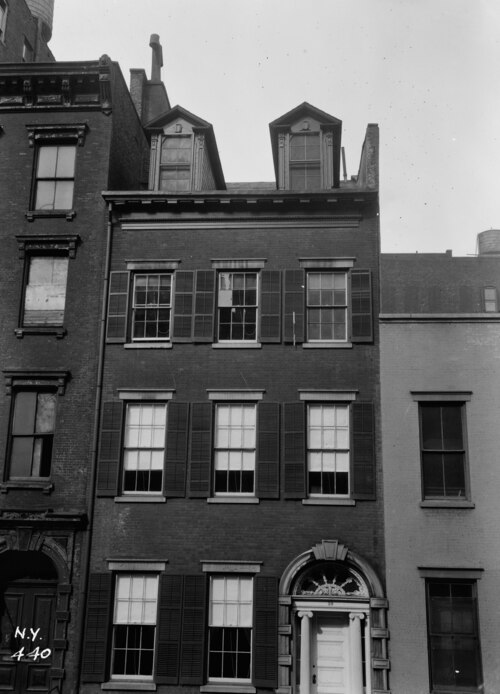
The resident ghost is Gertrude Tredwell, the youngest daughter, who was born in the house and died there at 93. Legend says her father disapproved of the man she loved, so she never married and never left. Visitors have reported seeing her near the main staircase and the front door, with the first sighting coming only days after her death.
The scariest chapter here, though, may be a modern real estate fight. In 2014 the Landmarks Preservation Commission approved a developer’s plan for an eight-story hotel on the garage lot next door at 27 East 4th Street. The museum sued in 2018, warning the fragile house might not survive the construction. The battle dragged on for years, and in 2024 the city approved new work next door with conditions such as enhanced vibration monitoring. This serves as a stark reminder that landmark status protects a building and not necessarily the lot beside it.
3. The Manhattan Well, SoHo: A Murder Beneath a Storefront
On December 22, 1799, a young woman named Gulielma “Elma” Sands left her Greenwich Street boarding house and never came back. Her body was found on January 2 at the bottom of the Manhattan Well, in what was then open meadow. A newspaper report from the time noted the well had been recently dug by the Manhattan Company, Aaron Burr’s water venture.
Suspicion fell on her secret sweetheart, carpenter Levi Weeks. His family hired Alexander Hamilton and Aaron Burr, who teamed up for the defense in what is often called the first recorded murder trial in U.S. history. The jury acquitted Weeks after about five minutes, but public opinion forced him out of the city.
Then came the real estate. By the 1820s, the meadow had been built up with upper-middle-class rowhouses, and the well ended up beneath 129 Spring Street. Staff reported strange happenings when the location was a Manhattan Bistro, and more recently, the space has housed a COS clothing store, with the old well reportedly visible on the lower level. The Travel Channel once ranked it among the most haunted places in America.
4. 14 West 10th Street, Greenwich Village: The “House of Death”
On one of the prettiest blocks near Washington Square Park sits a Greek Revival brownstone from the late 1850s with a grim nickname. According to 6sqft, 22 people have died in the house since it was built, and lore holds that it’s home to as many ghosts.
The most famous is Mark Twain, who lived there from 1900 to 1901, and potentially still does, as residents have reported seeing a figure in a white suit near the first-floor staircase. In a classic Manhattan real estate move, the single-family home was carved into 10 apartments in 1937. Actress Jan Bryant Bartell moved into a top-floor unit in 1957 and later wrote a book about the presence she felt there.
The building’s darkest chapter was all too real. In 1987, six-year-old Lisa Steinberg was fatally beaten in the home by Joel Steinberg, who was convicted of first-degree manslaughter. Under New York’s disclosure law, a seller generally isn’t required to volunteer that history, which is one reason the address remains a fixture on ghost-tour routes rather than listing descriptions.
5. The Dakota, Upper West Side: A Co-op With Celebrity Spirits
Few buildings blend luxury real estate and ghost lore like the Dakota at 1 West 72nd Street. It was built between 1880 and 1884 and became a city landmark in 1969, one year after its exterior starred as the sinister Bramford in Rosemary’s Baby.
The spooky stories started early. Some residents have reported objects moving on their own, and a basement apparition is said to resemble Edward Clark, the developer who died before the building was finished. In the 1960s, construction workers described a figure with a man’s body and a boy’s face.
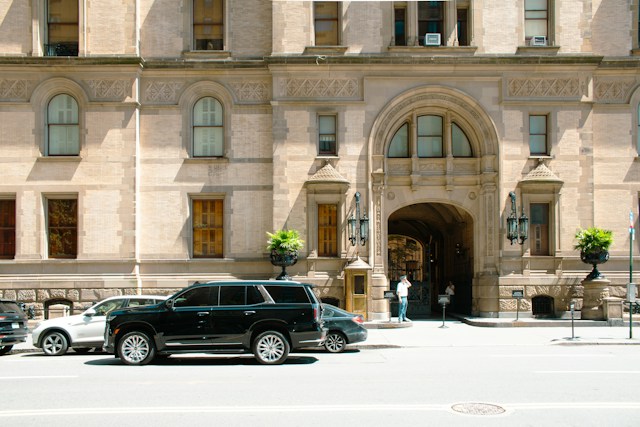
The building’s most famous story is also its saddest: John Lennon was killed outside in 1980, and Yoko Ono and others have said they’ve seen his ghost. None of it has dented demand. The Dakota remains prime Manhattan real estate with a famously selective co-op board.
6. Washington Square Park, Greenwich Village: Prime Real Estate Over a Potter’s Field
The ritziest addresses on Washington Square sit beside one of the city’s largest burial grounds. From roughly 1797 to 1825, the land was a potter’s field, and an estimated 20,000 people remain buried beneath the park, many of them yellow fever victims.
The site’s grim role was driven by real estate pressure. When a yellow fever wave in 1797 overwhelmed the old potter’s field at today’s Madison Square, the city moved burials here. As development crept north, the potter’s field moved again to what is now Bryant Park, and Washington Square was declared a public park in the 1820s.
The past keeps surfacing. In 2015, Con Ed crews working on a water main uncovered two intact burial vaults under Washington Square East. Even the park’s gravedigger, who doubled as the city’s hangman, lived on a plot that is now part of NYU.
Buying or Renting a Haunted Apartment in NYC: What You Should Know
In New York, the burden of finding out a property’s spooky past falls mostly on you. Here’s how stigmatized property works in practice, plus a few ways to dig into any address’s history.
- Deaths and crimes aren’t “material defects.” Under RPL § 443-a, sellers, landlords and agents can’t be sued just for not mentioning a homicide, suicide, other death or felony on the premises.
- Ask in writing anyway. The statute lets buyers submit a written question about these issues. The seller isn’t obligated to answer, but how they respond (or don’t) tells you something.
- Physical defects are a different story. Since March 20, 2024, sellers of one- to four-family homes can no longer skip the Property Condition Disclosure Statement by handing over a $500 credit, and the form now includes flood-risk questions. Note that co-ops and condos are exempt from that form.
- Self-promoted hauntings can still matter. Stambovsky shows a seller who actively publicizes a ghostly reputation and then stays quiet can face consequences.
- Do your own detective work. NYC’s ACRIS database lets you search deeds and other property records back to 1966, and the Department of Buildings systems show permits and violations. Old newspapers, landmark reports and a quick web search of the address fill in the rest.
- Don’t assume a ghost kills value. The Dakota is proof that a haunted reputation can coexist with top-dollar demand, and Eliza Jumel proved in 1810 that it can also be a bargaining chip.
The Bottom Line: Every NYC Address Has a Story
New York’s haunted real estate is really a story about how the city grows. Meadows became rowhouse blocks, a potter’s field became the Village’s most coveted square, and single-family mansions were carved into apartments. The ghosts, real or imagined, are what’s left behind. This fall, whether you’re touring an open house or just walking home through the leaves, look up. That brownstone may have a past it isn’t required to tell you about.
Frequently Asked Questions About Haunted NYC Real Estate
Do sellers have to disclose a haunted house in New York?
Not generally. New York’s RPL § 443-a says a death or felony on a property isn’t a material defect, and the law doesn’t require disclosing ghost stories. The exception is the Ghostbusters ruling, where a seller who had publicized the haunting was held responsible for not telling the buyer.
What is the “Ghostbusters ruling”?
It’s the nickname for Stambovsky v. Ackley, a 1991 New York appellate decision that let a buyer cancel his contract on a Nyack house the seller had promoted as haunted.
What is the oldest haunted house in Manhattan?
The Morris-Jumel Mansion in Washington Heights, built in 1765, is Manhattan’s oldest house and is said to be haunted by former owner Eliza Jumel.
What is the most haunted house in Manhattan?
The Merchant’s House Museum on East Fourth Street is often called the city’s most haunted house, thanks to sightings of Gertrude Tredwell.
Are there really bodies under Washington Square Park?
Yes. Historians estimate roughly 20,000 people are buried beneath the park, which served as a potter’s field from the late 1790s to the 1820s.
Can a landlord in NYC hide that someone died in an apartment?
New York law covers property offered for sale or lease, so landlords generally aren’t required to disclose a death on the premises. Renters can still ask directly.
Mr. "Hud" Chavij recently came from abroad and brought with him a level of determination and creativity that instantly gained him a reputation among the NYC real estate thought leaders.